Chinese family titles look intimidating at first because they are far more precise than English. English collapses many relatives into the same word (uncle, aunt, cousin), while Chinese makes the relationship explicit: which side of the family, older or younger, and sometimes even rank order. That precision is not just linguistic detail. It signals respect, closeness, and cultural awareness in daily conversation.
This is a practical guide for English readers who want usable rules, not theory. You will learn the core logic, the most common titles, and how to speak safely when you are unsure. By the end, you should be able to introduce relatives correctly, understand family stories, and avoid the most common mistakes. I learned this the awkward way years ago: getting the side wrong is usually more uncomfortable than getting the age wrong.
Everything here uses standard Mandarin. Local dialects add their own variations, but the logic is the same. If you are learning Chinese or working in a Chinese-speaking environment, these are the forms you will hear most often.
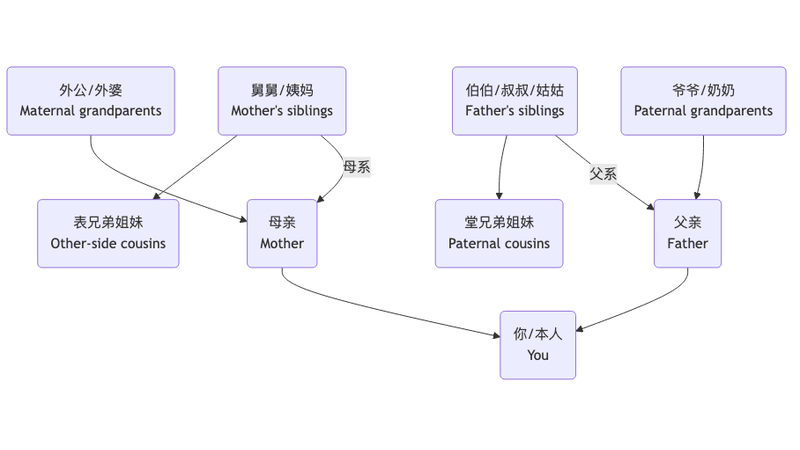
Here is the core idea: Chinese splits family terms into father-side and mother-side. Once you anchor that rule, everything else becomes much easier.
Why Chinese Family Titles Are So Detailed
Chinese kinship terms grew inside a culture that values family hierarchy, clarity of lineage, and respectful speech. In traditional settings, knowing the exact relationship was not just polite; it affected responsibilities, inheritance, ritual roles, and everyday etiquette. That history shaped the language, and you still hear it in everyday speech.
Today, the system is simpler in daily life, but it still carries cultural weight. When you address someone correctly, you show that you recognize their position in the family. When you use a wrong term, you are not being rude on purpose, but you may still sound careless or inexperienced. That is why mastering the basics makes a strong impression.
Think of Chinese titles as a map. You are not memorizing a random list; you are following a clear set of rules. Once you see the rules, you can deduce the right word even if you forget a specific term.
The One-Sentence Rule: Father-Side vs Mother-Side
If you remember only one thing, remember this:
- Father-side relatives use 伯 (bó)/叔 (shū)/姑 (gū).
- Mother-side relatives use 舅 (jiù)/姨 (yí).
This is the core structure. It tells you which word family to use before you worry about age or rank.
Grandparents: 爷爷奶奶 (yéye nǎinai) vs 外公外婆 (wàigōng wàipó)
The first clear example of the split is grandparents.
- Father’s parents: 爷爷 (yéye), 奶奶 (nǎinai)
- Mother’s parents: 外公 (wàigōng), 外婆 (wàipó)
The “外 (wài)” in 外公外婆 (wàigōng wàipó) signals “outside” of the father’s line. English does not separate these, but Chinese always does.
If you are talking about someone else’s grandparents, you can add “他 (tā)/她的 (tā de)” (his/her) or simply use the terms in context. For example: “她外婆很会做菜 (tā wàipó hěn huì zuò cài)” (Her maternal grandmother cooks very well).
Father-Side Uncles and Aunts: 伯伯 (bóbo), 叔叔 (shūshu), 姑姑 (gūgu)
On your father’s side, the key terms are 伯 (older brother), 叔 (younger brother), and 姑 (sister).
- 伯伯 (bóbo): your father’s older brother
- 叔叔 (shūshu): your father’s younger brother
- 姑姑 (gūgu): your father’s sister
Their spouses have their own names:
- 伯母 (bómǔ): your 伯伯 (bóbo)’s wife
- 婶婶 (shěnshen): your 叔叔 (shūshu)’s wife
- 姑父 (gūfu): your 姑姑 (gūgu)’s husband
In daily life, people often add rank or age:
- 大伯 (eldest uncle), 二叔 (second uncle), 小姑 (youngest aunt)
If you know the family order, this sounds natural and respectful. If you do not know the order, “伯伯 (bóbo)/叔叔 (shūshu)/姑姑 (gūgu)” still works.
Example sentences:
- 我大伯以前在上海工作 (wǒ dàbó yǐqián zài shànghǎi gōngzuò)。 (My eldest father-side uncle used to work in Shanghai.)
- 这是我叔叔 (zhè shì wǒ shūshu),他比我爸小 (tā bǐ wǒ bà xiǎo)。 (This is my father’s younger brother.)
- 姑姑今天来我们家吃饭 (gūgu jīntiān lái wǒmen jiā chīfàn)。 (My father’s sister is coming over for dinner.)
Mother-Side Uncles and Aunts: 舅舅 (jiùjiu), 姨妈 (yímā)/阿姨 (āyí)
On your mother’s side, the terms are different:
- 舅舅 (jiùjiu): your mother’s brother
- 姨妈 (yímā)/阿姨 (yímā/āyí): your mother’s sister
Their spouses:
- 舅妈 (jiùmā): your 舅舅 (jiùjiu)’s wife
- 姨父 (yífu): your 姨妈 (yímā)’s husband
A common confusion is “阿姨 (āyí).” In daily conversation, 阿姨 (āyí) also means a polite term for an older woman who is not family (like “auntie”). But within family, 阿姨 (āyí) still refers to your mother’s sister. Context matters.
Example sentences:
- 我舅舅特别喜欢摄影 (wǒ jiùjiu tèbié xǐhuan shèyǐng)。 (My mother’s brother loves photography.)
- 姨妈下周要来北京 (yímā xiàzhōu yào lái běijīng)。 (My mother’s sister is visiting Beijing next week.)
- 这是我姨父 (zhè shì wǒ yífu),他是老师 (tā shì lǎoshī)。 (This is my aunt’s husband; he is a teacher.)
Cousins: 堂 (táng) vs 表 (biǎo) in One Decision Tree
Cousins are where most learners get stuck. The rule is surprisingly clean once you see it:
- 堂 (táng) cousins are children of your father’s brothers.
- 表 (biǎo) cousins are children of everyone else (mother’s siblings or father’s sisters).
So the decision tree looks like this:
- Is this cousin from your father’s brother? → 堂 (táng)
- Is this cousin from your mother’s side or your father’s sister? → 表 (biǎo)
Examples:
- Your father’s younger brother’s son = 堂弟 (tángdì)
- Your father’s older brother’s daughter = 堂姐 (tángjiě)
- Your mother’s sister’s son = 表弟 (biǎodì)
- Your father’s sister’s daughter = 表姐 (biǎojiě)
The distinction comes from traditional lineage and shared family names. 父系兄弟 (fùxì xiōngdì) share the same family name, so their children are “堂 (táng).” Everyone else is “表 (biǎo).”
If you only remember one cousin rule, remember this: father’s brothers → 堂 (táng); everyone else → 表 (biǎo).
In conversation, people sometimes drop 堂 (táng)/表 (biǎo) when the context is obvious and just say 哥 (gē)/姐 (jiě)/弟 (dì)/妹 (mèi) with a name. But when you first meet relatives, the full term is safer because it signals your exact relationship. If you married into the family, you will hear your spouse use cousin titles; you can mirror their choice. Some modern families blur 堂 (táng) and 表 (biǎo) for convenience, yet the distinction still matters in formal introductions or family stories.
Age and Rank: 大伯 (dàbó), 二叔 (èrshū), 表哥 (biǎogē), 表姐 (biǎojiě)
Chinese also marks relative age. For siblings and cousins, this matters in conversation:
- 哥哥 (gēge) / 姐姐 (jiějie) = older brother / older sister
- 弟弟 (dìdi) / 妹妹 (mèimei) = younger brother / younger sister
So cousin terms combine side + age:
- 堂哥 (tánggē) / 堂姐 (tángjiě) / 堂弟 (tángdì) / 堂妹 (tángmèi)
- 表哥 (biǎogē) / 表姐 (biǎojiě) / 表弟 (biǎodì) / 表妹 (biǎomèi)
If you do not know the exact age, you can use a neutral form or ask. In friendly settings, people may also say “表兄 (biǎoxiōng)” or “表妹 (biǎomèi)” as a quick shortcut, but standard forms are safest.
For uncles and aunts, people often add rank:
- 大伯 (oldest father-side uncle)
- 二叔 (second father-side uncle)
- 小姨 (youngest mother-side aunt)
If you are unsure, you can simply say “叔叔 (shūshu)/阿姨 (āyí)” as a safe default and then confirm later.
A Simple Family Tree Walkthrough
Imagine a typical family reunion. Your father has an older brother and a younger brother, plus one sister. Your mother has one brother and one older sister. Here is how you would name everyone:
- Father’s older brother → 伯伯 (bóbo)
- Father’s younger brother → 叔叔 (shūshu)
- Father’s sister → 姑姑 (gūgu)
- Mother’s brother → 舅舅 (jiùjiu)
- Mother’s older sister → 姨妈 (yímā)
Now add the next generation. The son of your father’s older brother is your 堂哥 (if he is older than you), while the daughter of your father’s sister is your 表姐 (biǎojiě). Your mother’s brother’s daughter is 表妹 (biǎomèi). The key is always the parental line: father’s brothers create 堂 (táng) cousins; everyone else becomes 表 (biǎo).
When people explain their families in Chinese, they often chain relationship words together. For example: “这是我爸爸的哥哥 (zhè shì wǒ bàba de gēge),他的儿子是我堂弟 (tā de érzi shì wǒ tángdì)。” That sentence may feel long in English, but in Chinese it sounds clear and natural because each term signals a precise relationship.
If you are unsure about age, you can temporarily skip it and use a neutral cousin phrase, then correct later. But when you do know the order, using 哥 (gē)/姐 (jiě)/弟 (dì)/妹 (mèi) makes you sound much more fluent and respectful.
Modern Usage and Regional Variation
Modern families sometimes simplify terms in casual settings. In cities, you may hear young people call several older relatives “叔叔 (shūshu)” or “阿姨 (āyí)” as a broad, polite default, especially when they are not very close. In a formal family gathering or when introducing elders, however, the precise terms usually return.
Regional differences also appear. Some families shorten 舅舅 (jiùjiu) to 舅 (jiù) or 姨妈 (yímā) to 姨 (yí). Others use dialect-specific words that are not common in standard Mandarin. If you are learning Chinese for daily use, stick to the standard forms in this guide. They are widely understood and safe in almost every context.
The best strategy is to use the standard term first, and then mirror what the family uses. That approach shows respect while helping you adapt naturally to local habits.
How to Talk About Your Family in Chinese
Knowing titles is one thing; using them smoothly is another. These patterns help you speak naturally:
- 这是我爸爸的哥哥 (zhè shì wǒ bàba de gēge)。 (This is my father’s older brother.)
- 这是我妈妈的妹妹 (zhè shì wǒ māma de mèimei)。 (This is my mother’s younger sister.)
- 我表姐在深圳工作 (wǒ biǎojiě zài shēnzhèn gōngzuò)。 (My older female cousin from the “表 (biǎo)” side works in Shenzhen.)
- 我堂弟比我小两岁 (wǒ tángdì bǐ wǒ xiǎo liǎng suì)。 (My younger male cousin from the “堂 (táng)” side is two years younger than me.)
Notice that Chinese often combines a relationship word with a short description. You do not have to be perfect. If you use the correct side word (伯 (bó)/叔 (shū)/姑 (gū) vs 舅 (jiù)/姨 (yí)), people will understand even if you skip details.
You can also use a two-step pattern: describe the relationship first, then give the title. For example: “这是我爸爸的妹妹 (zhè shì wǒ bàba de mèimei),她是我的姑姑 (tā shì wǒ de gūgu)。” This format is helpful when you are unsure if your listener understands the title alone. It also gives you time to confirm the exact term if needed.
When you talk about someone else’s family, use the same logic: “他妈妈的哥哥是他舅舅 (tā māma de gēge shì tā jiùjiu)。” The structure is simple, and it keeps your description precise without sounding unnatural.
In-Law Titles You Will Hear Often
Marriage adds another layer. The most common in-law terms are:
- 岳父 (yuèfù) / 岳母 (yuèmǔ): your wife’s father / mother
- 公公 (gōnggong) / 婆婆 (pópo): your husband’s father / mother
You may also hear these in daily talk:
- 老丈人 (lǎozhàngren) / 丈母娘 (zhàngmǔniang) (more colloquial for 岳父 (yuèfù)/岳母 (yuèmǔ))
- 媳妇 (xífù) / 女婿 (daughter-in-law / son-in-law)
If you are not married, you still need to recognize these terms in stories or introductions. They are common in Chinese conversation.
Real-Life Usage: What to Say When You Are Not Sure
Even native speakers sometimes pause to think. The good news: politeness and honesty go a long way.
Safe strategies:
- Use a polite default first. “叔叔 (shūshu)/阿姨 (āyí)” works for most older relatives you do not know well.
- Ask directly but gently. “我应该怎么称呼您更合适 (wǒ yīnggāi zěnme chēnghu nín gèng héshì)?” (How should I address you?)
- Use the relationship description. “这是我妈妈的姐姐 (zhè shì wǒ māma de jiějie)。” (This is my mom’s older sister.)
Common mistakes to avoid:
- Calling a mother-side uncle “叔叔 (shūshu).” (Should be 舅舅 (jiùjiu).)
- Calling a father-side aunt “阿姨 (āyí).” (Should be 姑姑 (gūgu).)
- Calling all cousins “表 (biǎo)” without checking if it is a father-side brother’s child.
A good rule: if the person belongs to your father’s direct brother line, think “堂 (táng).” Otherwise, think “表 (biǎo).”
If you are introducing someone at a gathering, a short line is enough: “这是我舅舅 (zhè shì wǒ jiùjiu)。” Then use their name if you know it. If you are the listener, a brief response like “您好 (nín hǎo),舅舅 (jiùjiu)” is polite even if you are not closely related. The clarity itself is the respectful part.
Quick Cheat Sheet
- Father-side: 伯伯 (older uncle), 叔叔 (younger uncle), 姑姑 (aunt)
- Mother-side: 舅舅 (uncle), 姨妈 (yímā)/阿姨 (aunt)
- Grandparents: 爷爷奶奶 (father-side), 外公外婆 (mother-side)
- Cousins: 堂 (táng) = father’s brothers’ children; 表 (biǎo) = everyone else
- In-laws: 岳父岳母 (wife’s parents), 公公婆婆 (husband’s parents)
FAQ
1) Can I call all older women “阿姨 (āyí)”?
In daily life, yes. In a family setting, 阿姨 (āyí) usually means your mother’s sister. For your father’s sister, use 姑姑 (gūgu).
2) Is “舅舅 (jiùjiu)” only for my mother’s brothers?
Yes. If the uncle is on your father’s side, use 伯伯 (bóbo) or 叔叔 (shūshu) instead.
3) How do I choose between 堂 (táng) and 表 (biǎo)?
If the cousin is from your father’s brothers, use 堂 (táng). If the cousin is from your mother’s side or your father’s sisters, use 表 (biǎo).
4) What if I do not know whether someone is older or younger than me?
Use a neutral form first (like 表哥 (biǎogē)/表姐 (biǎojiě) if they are clearly older), or ask politely. Many families also accept the more general “表兄弟姐妹 (biǎo xiōngdì jiěmèi).”
5) Do people still use all these titles today?
Yes, especially in family gatherings and formal introductions. Younger people may shorten some forms, but the core system remains.
6) Are there regional differences?
Yes. Dialects can change pronunciation or use local terms, but the father-side vs mother-side split is consistent across China.