The red paper that marks a new year
A few days before Lunar New Year, many streets in China start to look different. You see folding tables, ink stones, stacks of long red paper, and people gathering around to watch someone write.
What people bring home is not just decoration. It is language: handwritten, familiar, and full of intent.
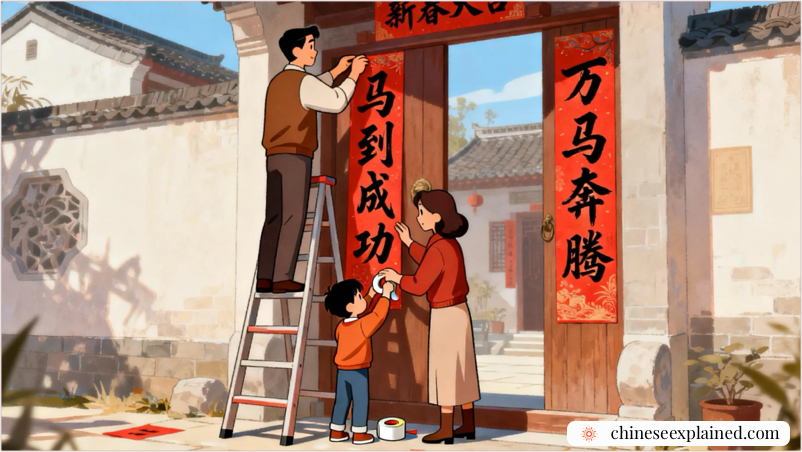
These red strips are Spring Festival couplets (春联, chūnlián). Families paste them on both sides of the door and add a short horizontal line above the frame. The doorway becomes a clear signal: the old year is over, and the new one has begun.
To a visitor, they might look like festive calligraphy. To people who grew up with them, they feel more like a shared social habit. You put them up because everyone does, but also because you want to start the year by saying something hopeful out loud.
What a Spring Festival couplet set includes
Spring Festival couplets are part of the broader Chinese couplet tradition (对联, duìlián), where two lines mirror each other in rhythm, structure, and meaning.
A standard New Year set has three parts:
- upper line (上联, shànglián)
- lower line (下联, xiàlián)
- horizontal scroll above the door (横批, héngpī)
The New Year version is seasonal. The themes are consistent: peace, health, prosperity, family harmony, smooth luck, and success in study or work. The wish stays the same; only the wording changes.
Most people buy printed sets now. Handwritten ones still feel special. You can see the pressure of the brush, the pace of the strokes, even small pauses where the writer adjusted. It feels less like a product and more like something made for a specific moment.
One character, many blessings
In some homes, one character can stand in for a full pair of couplets.
This is the “Hundred Fu” tradition (百福, bǎi fú): a decorative sheet centered on 福 (fú, blessing), written over and over in different calligraphy styles. Some versions have dozens of forms. Some have more than a hundred.
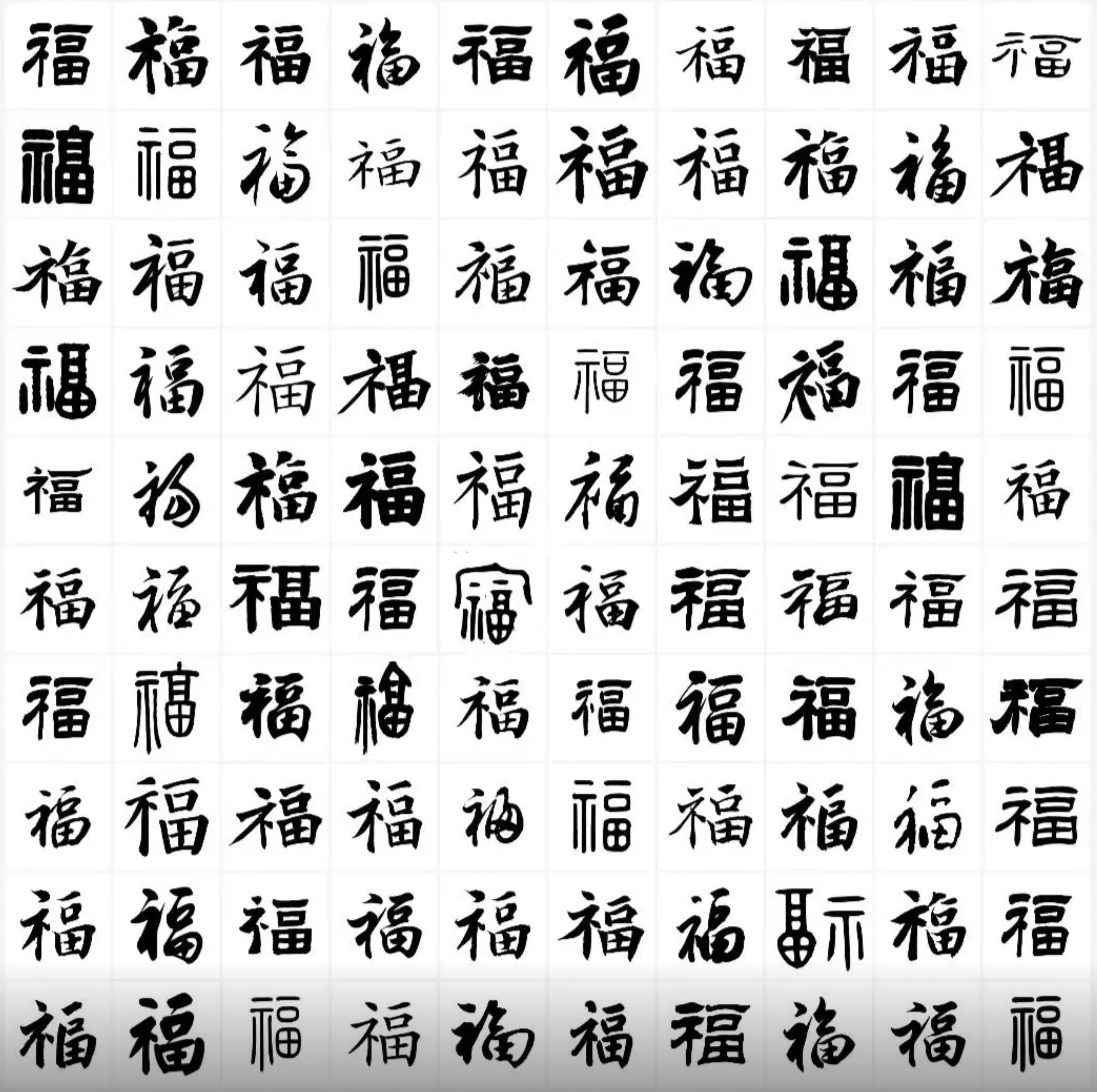
Each “fu” comes from a different script tradition: seal script, clerical script, regular script, running script, plus personal variations from individual calligraphers. You keep seeing the same character, but never in exactly the same shape.
The idea is simple. One 福 is good luck. A hundred 福 means that wish is repeated again and again.
For many families, hanging a bǎi fú print by the entrance is not about showing off calligraphy. It is about gathering wishes in one image: health, peace, prosperity, and long life, all folded into a single character rewritten many times.
From protection charms to festive poetry
Before paper couplets, households used peachwood charms (桃符, táofú). People hung peachwood boards on doors to ward off evil spirits. Later they added written phrases, and over time paper replaced wood.
That shift matters. The function moved from pure protection to expression. By the Song and Ming periods, poetic door couplets were already a familiar part of festival life.
The protective meaning never disappeared entirely, but celebration became the main focus. Modern couplets are less about keeping bad luck out and more about inviting good things in.
Why New Year’s Eve matters
People usually paste couplets on Chinese New Year’s Eve (除夕, chúxī). In northern China, you often hear “大年三十” (dànián sānshí) used for the same day, even in years when the lunar month ends on the 29th. At this point, it means “the last day of the old year,” not a strict calendar count.
The process is usually practical and family-based, not ceremonial:
- clean the door
- remove old couplets
- brush glue or apply tape
- align each strip carefully
- step back and adjust
One detail often surprises newcomers: from the viewpoint outside the door, the upper line goes on the right and the lower line on the left. That follows traditional right-to-left reading order in classical Chinese.
Small moments that keep it alive
What keeps this tradition alive is not one grand story. It is small repeated scenes:
- a grandfather smoothing one corner after spotting a wrinkle
- a teenager holding tape while laughing with her grandmother
- a young couple ordering their first handwritten set online
Most of these moments are never documented. Together, they are the real archive.
Common characters everyone recognizes
Even if someone cannot parse every line, they can usually recognize key characters on sight:
- 福 (fú): blessing, good fortune
- 春 (chūn): spring
- 吉 (jí): auspicious
- 安 (ān): peace, safety
- 顺 (shùn): smooth progress
- 财 (cái): wealth
- 喜 (xǐ): joy
- 年 (nián): year, also linked with abundance
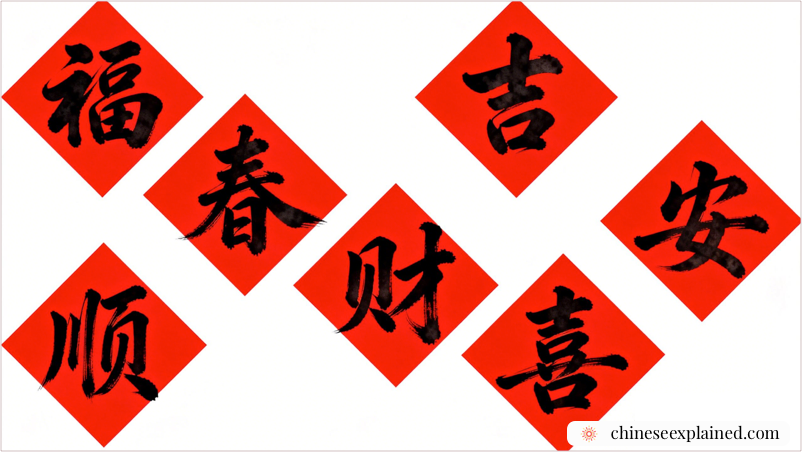
These are compact symbols. One character can carry an entire wish.
Couplets also work through paired meaning: spring with joy, peace with harmony, wealth with diligence. Symmetry is not just a visual trick. It reflects a preference for balance in life itself.
Why red remains central
Red is not only a design choice. In Chinese culture, it signals celebration, vitality, and protection. During New Year, red couplets, red lanterns, and red envelopes create one connected visual environment.
In winter streets, red does practical work. It announces that a household is ready for the holiday.
When the color changes: mourning and green couplets
There is one quiet exception to all that red.
If a family has lost a close relative within the past year, they may use green Spring Festival couplets instead of red. In many places, that means the home is still observing mourning.
The meaning is straightforward. Red is tied to celebration and visible joy. During mourning, families avoid strong festive colors out of respect for the person who died.
So if you notice green couplets during New Year, it often says something without saying it directly: someone in that household passed away recently. A small detail, but people understand it immediately.
More than decoration
Calling couplets “festive calligraphy” is correct, but incomplete.
They are also social signals. Fresh couplets suggest readiness to host and participate. Torn or missing ones can quietly signal that a family is away, ill, or under stress. Neighbors notice.
In that sense, couplets are part of New Year social rhythm, not just visual style.
Humor and modern life
Playful couplets are increasingly common, especially among younger families. Some mix classical structure with internet slang, references to rent, overtime, and city commuting.
The tone changes, but the format still holds. The tradition adapts without breaking.
Final thought
On New Year’s Eve, once the last strip is pressed flat and the glue dries, the doorway looks different.
The couplets do not guarantee anything. They do something simpler: they let people hope together, in plain sight.
That is why they continue, year after year.