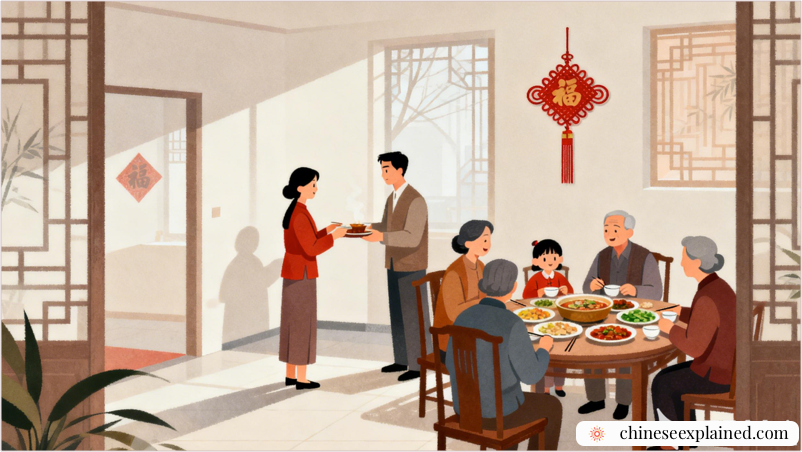
What is Chúxī?
Chinese New Year’s Eve(除夕, Chúxī) is the last night of the lunar year and, for many families, the emotional center of the Spring Festival.
The term is simple but meaningful: 除 (chú) means to clear away, and 夕 (xī) means evening. Together, they point to a farewell to the old year and a quiet step toward the new one.
New Year’s Day is public: visits, greetings, and movement. Chúxī is private. It is a night for returning, gathering, remembering, and, just as importantly, staying put.
Morning: putting up Spring Festival couplets
By late morning, doorways start to change.
Families paste Spring Festival couplets(春联, chūnlián) on both sides of the door, with a horizontal banner called 横批 (héngpī) above. From the viewer’s perspective, the upper line(上联, shànglián) is placed on the right, and the lower line(下联, xiàlián) on the left. The arrangement quietly follows traditional reading order.
The ritual itself is ordinary and careful: old paper comes down, glue goes on, and someone steps back to check alignment. There is rarely formal ceremony, but there is attention.
By noon, whole apartment corridors glow with new red paper.
Noon: honoring ancestors
In some households, midday is set aside for remembrance.
Incense is lit. Food is set out. Family members bow at home altars or visit ancestral graves. This is often referred to as ancestor worship(祭祖, jìzǔ).
For younger family members, the moment may feel brief. Still, its place on Chúxī matters. It puts the coming year inside a longer family timeline, one that includes people no longer physically present.
The New Year, in other words, begins with acknowledgment.
Evening: the reunion dinner
If Chúxī has one defining moment, it is dinner.
The meal is the reunion dinner(年夜饭, nián yè fàn). It resembles Thanksgiving in the United States in one sense—everyone tries to come home—but it carries heavier symbolic meaning. For many families, this is the one night when attendance is expected if at all possible.
The table is crowded, noisy, and full.
Many dishes carry wishes:
- Fish(鱼, yú), because it sounds like “surplus”
- Dumplings(饺子, jiǎozi), shaped like ancient gold ingots
- Sticky rice cake(年糕, niángāo), linked to growth and progress
Abundance is intentional. Leftovers are welcome. The year should begin with visible plenty.
Fireworks and the old fear of monsters
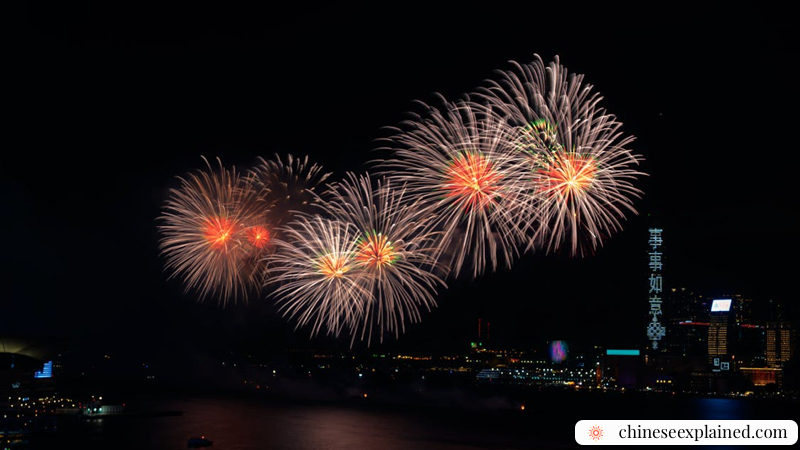
After dinner, the evening opens outward.
Where permitted, fireworks and firecrackers still echo the old story of Nian(年兽, Nián shòu), a creature believed to appear at year-end. Loud sound, fire, and red were thought to drive it away.
Most people now hold the story as cultural memory rather than literal belief. But when the sky flashes red and white over dark streets, the gesture still lands: danger belongs to the old year.
Red envelopes, passed quietly
At some point in the evening, children start hoping gifts.
They are waiting for red envelopes(红包, hóngbāo)—small red packets of money from elders. The meaning is less financial than symbolic: protection, good fortune, and care handed down across generations.
Digital red envelopes sent through apps are now just as common. A phone vibrates, an alert appears, and tradition arrives through a tap.
The long night: Spring Festival Gala
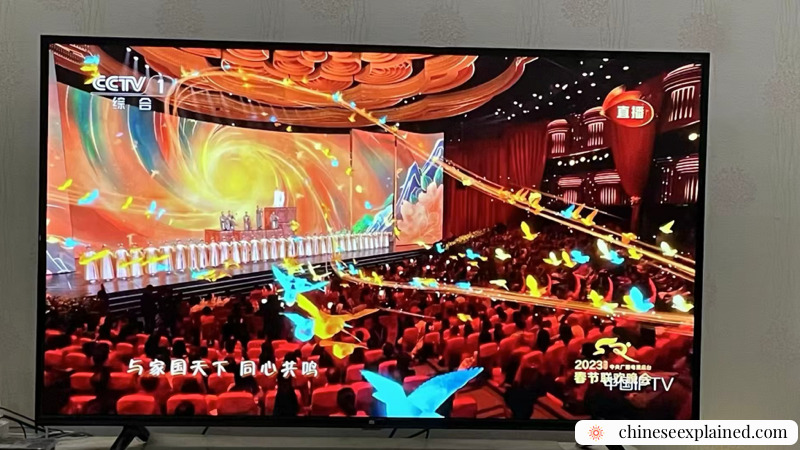
In many homes, the television stays on for hours.
The Spring Festival Gala(春晚, Chūnwǎn)—a live, nationally broadcast variety show—cycles through comedy, pop songs, traditional opera, dance, and celebrity appearances.
Few people watch every segment closely. Almost everyone keeps it on anyway. It works less as focused entertainment and more as shared background, a common clock counting down to midnight.
Staying awake together
The custom of staying up late is called 守岁 (shǒu suì).
Literally, it means “guarding the year.” Traditionally, it was tied to wishes for parents’ longevity and to protecting the household through the night. In modern homes, it often looks simpler: card games, quiet chats, scrolling on phones, half-finished snacks on the table.
The symbolic core remains the same. You stay awake to accompany the old year to its final minute.
Regional and modern variations
Chúxī is celebrated nationwide, but no two households do it exactly the same way.
In northern China, dumplings are essential. In many southern regions, rice cakes(年糕, niángāo)take center stage. Along the southeastern coast and in overseas Chinese communities, raw fish salad and seafood-heavy spreads are common.
Urban families may eat in restaurants instead of at home. Migrant workers may gather with colleagues rather than relatives. Video calls connect parents in one city with children in another country.
The structure stays recognizable—couplets, dinner, television, red envelopes, staying up—while the setting keeps changing.
Why this night still matters
Chúxī is not mainly spectacle. It is a pause.
It gathers cleaning, decorating, remembering, eating, laughing, giving, and waiting into one unhurried night. It lets families close one chapter before opening the next.
When midnight finally arrives, the doorways already carry new words. The table is still messy. Someone is still awake on the sofa.
And the new year arrives just like that—in laughter, noise, and flickering light.