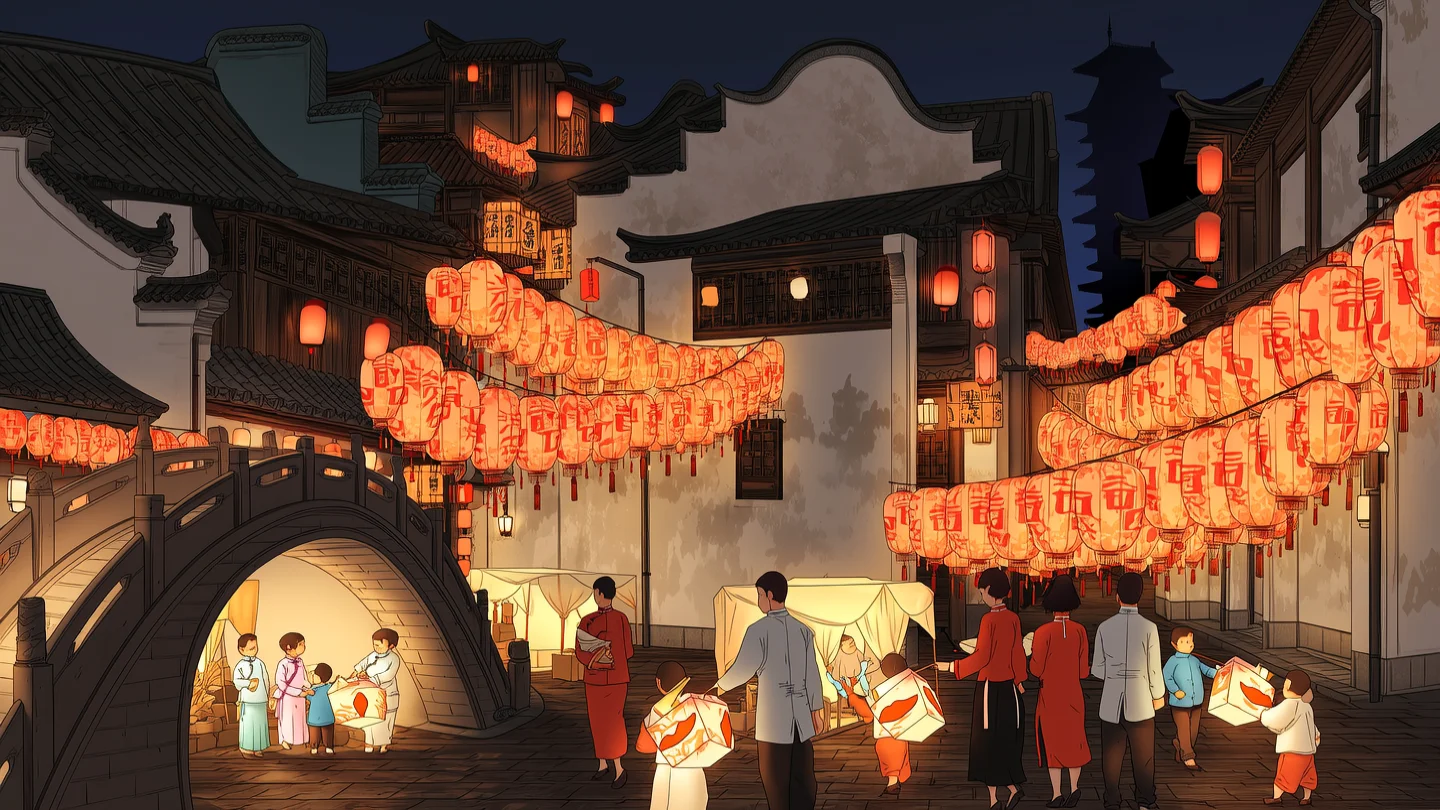
The night when the city turns into light
By 7:00 p.m., the street looks different.
A lane that felt ordinary at noon is now covered in red lanterns. Children point up. Elderly couples walk slowly under the lights. Street vendors call out over steam and sugar. Tourists lift their phones, then lower them, because for once the camera cannot quite hold the mood.
This is the Lantern Festival in China, usually called 元宵节 (Yuánxiāo Jié), and it lands on the fifteenth day of the first lunar month, 正月十五 (Zhēngyuè Shíwǔ). Most people treat it as the closing night of the Chinese New Year season, 春节 (Chūnjié). It is the point where family routines, neighborhood life, food memories, and public celebration all meet.
If you want to know what Lantern Festival in China actually feels like, this guide is for you. It is written for readers interested in Chinese culture, planning a trip, or already living in China and trying to understand local life in a clearer way.
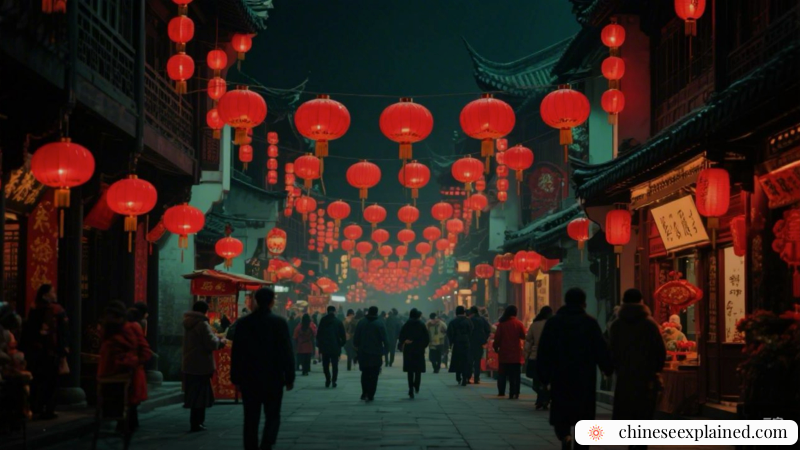
What is the Lantern Festival, exactly?
A lot of English introductions reduce the festival to one line: “people look at lanterns and eat sweet rice balls.” That is true, but incomplete.
Think of Lantern Festival as the social finale of the New Year period.
Across the New Year period, families move through a sequence: homecoming, reunion dinner, visiting relatives, ritual greetings, and finally a more public, outward-facing celebration. Lantern night is when private holiday energy spills into streets, parks, temple fairs, riversides, shopping districts, and old town blocks.
Historically, scholars commonly trace early forms of lantern observances to imperial periods, with stronger urban festival culture developing in later dynasties. In modern China, the form changes by city and county, but the core pattern remains recognizable:
- people go out after dark
- lights become the main visual language
- symbolic foods are shared
- games like lantern riddles create participation
That last point matters. Lantern Festival is not just something to watch. It is something people actively do.
Why this festival still matters in Chinese culture
The most useful keyword here is 团圆 (tuányuán), often translated as togetherness or reunion. During the New Year season, Chinese festival language keeps returning to that idea: not only success and luck, but being together.
Lantern night adds one more thing: visibility.
During the holiday, people spend time inside homes. On Lantern Festival, they come out. Homes, lanes, squares, and public landmarks become part of a shared stage. Families do not just celebrate with each other; they celebrate in front of each other, alongside neighbors and strangers.
That shift from private to public is why the atmosphere feels distinct from New Year’s Eve.
Light carries symbolism here. Lanterns are practical, decorative, and emotional at the same time. They suggest spring, warmth, and continuity after winter. In crowded cities, they also soften the mood for a few hours. Even commercial districts can feel less transactional for one evening.
For overseas readers, this can be hard to map onto Western holiday categories. Lantern Festival is not exactly the same as Christmas markets, New Year’s fireworks, or harvest fairs. It overlaps with each of them a little, but culturally it stands on its own.
A short walk through what you actually see
Lantern displays: from temple gates to mall atriums
In older districts, lantern displays may look handcrafted and locally themed: zodiac animals, folk opera faces, mythical creatures, local legends. In newer commercial zones, you may see giant installation-style lantern sets with immersive lighting and brand sponsorship.
Both are real Lantern Festival experiences.
The first grows out of neighborhood memory. The second shows how festivals adapt inside modern city life. Both can coexist.
If you are traveling, one practical trick is to do both in one evening:
- start in a traditional area before peak crowd time
- move to a major public installation later
That gives you a better feel for how festival life works in China today.
Lantern riddles: 灯谜 (dēngmí)
Lantern riddles, 灯谜 (dēngmí), are one of the most interactive parts of the night.
A riddle is written on paper and attached to a lantern. You read, guess, and sometimes submit your answer to a staff table or host. In some venues there are small prizes. In others, the game is purely for fun.
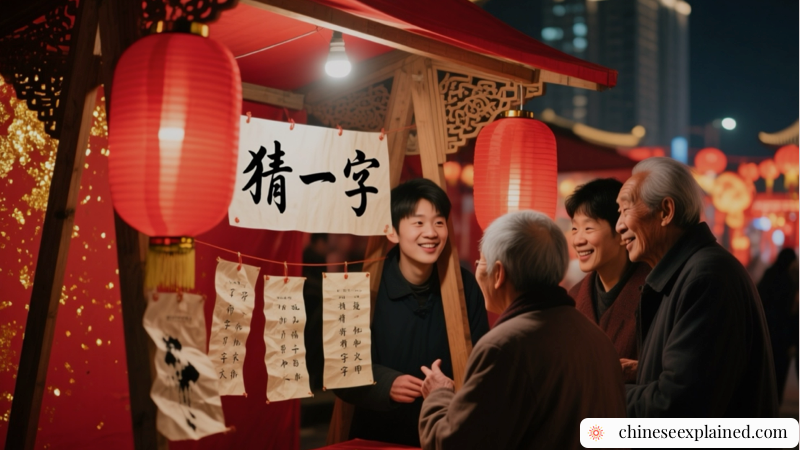
For Chinese learners, this is a high-context experience. Many riddles rely on wordplay, homophones, character structure, or cultural references that do not translate neatly. Even advanced learners miss punchlines. That is normal.
If you are visiting as a foreign reader, the best approach is simple:
- try one or two riddles for experience
- ask a local friend to explain one answer in detail
- treat confusion as part of the fun, not failure
One short conversation like this can teach more about Chinese language culture than several textbook examples.
Performances: 舞龙 (wǔlóng) and 舞狮 (wǔshī)
Depending on region, you may see dragon dance, 舞龙 (wǔlóng), lion dance, 舞狮 (wǔshī), waist drums, local opera snippets, or modernized stage choreography.
What first-time visitors often notice is rhythm: loud percussion, dense movement, fast transitions, call-and-response energy from crowds.
What locals often notice is social texture: which troupe is from which district, whether performers are community teams or professional groups, how children imitate dance moves while watching.
So if you want to understand the event beyond surface spectacle, watch the audience as much as the stage.
Yuanxiao versus tangyuan: the question everyone asks
If you search Lantern Festival food, you will quickly meet two names: 元宵 (yuánxiāo) and 汤圆 (tāngyuán).
Both are glutinous-rice balls linked to reunion symbolism. Both can be sweet. Both are common during Lantern Festival. But they are not identical.
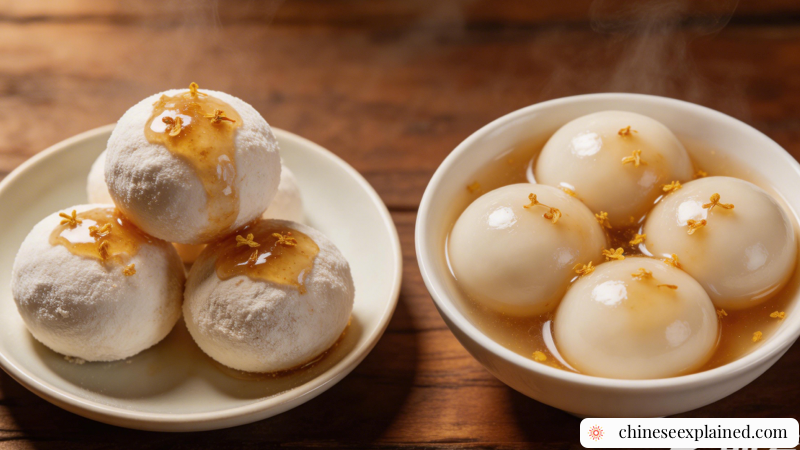
Method difference
In many northern traditions, 元宵 (yuánxiāo) are made by repeatedly rolling filling pieces in glutinous rice flour until layers build up. The texture can feel looser and slightly rougher on the surface.
In many southern traditions, 汤圆 (tāngyuán) are wrapped more like stuffed dough: a smooth glutinous skin surrounds filling. The exterior is often more even and elastic.
Texture and flavor difference
Yuanxiao can absorb soup differently and sometimes has a grainier bite.
Tangyuan tends to feel smoother and more cohesive, especially when freshly cooked.
Classic sweet fillings include black sesame, peanut, red bean paste, and mixed nuts. In modern cities, you may also find savory, low-sugar, fruit, tea, or limited-time trend versions.
Symbolic overlap
Regardless of style, the round shape is linked to completeness and family unity. That is why discussions of Lantern Festival food nearly always return to reunion language.
What first-time visitors should order
If a menu offers both and you are unsure:
- choose black sesame 汤圆 (tāngyuán) for the safest first bite
- try 元宵 (yuánxiāo) in a traditional snack street for contrast
- share portions with friends so you can compare textures
For many visitors, the food ends up being the strongest memory of the night.
How to join the festival politely as a visitor
For potential travelers and expats in China, etiquette anxiety is common: “I do not want to be rude.”
The good news is that Lantern Festival is forgiving. Most people value curiosity and basic respect more than perfect behavior.
Crowd behavior basics
- Keep moving in narrow lanes; do not stop suddenly for photos.
- If you need a static photo, step to the side first.
- Follow queue order around popular lantern installations.
- Watch children and older adults in dense areas.
These are small actions, and locals notice them immediately.
Photo etiquette
Festival spaces feel public, but families still value boundaries.
- Wide crowd shots are usually fine.
- For close portraits, ask first with a smile or gesture.
- Do not block performance sightlines for long video clips.
If you attend temple fair zones, follow posted signs about flash and restricted areas.
Language: useful greeting lines
You do not need long speeches. Short lines are enough.
- 元宵节快乐 (Yuánxiāo Jié kuàilè) — Happy Lantern Festival.
- 新年快乐 (Xīnnián kuàilè) — Happy New Year.
- 阖家团圆 (Héjiā tuányuán) — Wishing family reunion.
Use one line naturally and at the right moment. A sincere phrase works better than a forced performance.
Practical planning for Lantern Festival in China
If your goal is to experience the festival well, logistics matter as much as culture.
Timing strategy
Crowds usually build after dinner, often peaking in the evening.
A practical schedule for first-time visitors:
- arrive before peak time
- do your walking circuit early
- eat before the largest crowd wave
- choose one highlight zone instead of chasing everything
This lowers stress and makes the night much easier to enjoy.
Clothing and comfort
Weather around late winter and early spring can shift quickly. Wear layers, comfortable shoes, and keep hands free when possible. Many people underestimate how much walking a lantern night involves.
Transport reality
On major festival nights, traffic and ride-hailing wait times may increase around high-profile venues. Public transit can be more reliable than private car pickup points in dense areas.
If you already live in China, this may sound obvious. If you are visiting from abroad, build in buffer time.
How the festival is changing in modern China
If you read only nostalgic descriptions, you might think Lantern Festival is a static tradition preserved exactly as it was centuries ago. That is not how culture works on the ground.
Modern Lantern Festival in China includes at least three layers:
- heritage layer — local rituals, folk arts, food memory, family practice
- urban event layer — city branding, tourism programming, public installations
- digital layer — short video platforms, social sharing, visual trends, meme language
These layers sometimes clash, but together they keep the festival alive.
Some people dislike overly commercial designs. Others argue that large productions keep younger audiences engaged. Both views can be valid, depending on context.
What matters is that participation remains broad. Grandparents, students, office workers, children, photographers, food vendors, temple volunteers, and tourists all share the same night, each for different reasons.
That social mixing is one reason Lantern Festival still feels culturally durable.
FAQ: fast answers for search readers
Is Lantern Festival a public holiday in China?
In most years it is observed culturally but not treated as a nationwide statutory day off. Work and school schedules can remain normal depending on local arrangements and calendar structure.
Where should first-time visitors experience it?
Choose based on your tolerance for crowds.
- Big cities: stronger visual production and transport options
- Smaller cities or counties: slower pace and often more local texture
A mixed plan works best if your schedule allows it.
What should I eat first: yuanxiao or tangyuan?
Start with 汤圆 (tāngyuán) if you prefer a smoother texture, then try 元宵 (yuánxiāo) to understand the northern-style rolling method and mouthfeel differences.
What should I avoid during peak lantern events?
Avoid last-minute planning, heavy bags, and rigid itineraries. Lantern Festival works best when you move flexibly, pause when needed, and focus on a few things.
Do I need strong Chinese skills to enjoy Lantern Festival?
No. Basic courtesy, observation, and a few greetings are enough for a meaningful first experience.
Why this night stays with people
By late evening, some lanterns begin to dim. Vendors pack up slowly. Families start heading home. The city does not stop all at once; it exhales.
For many first-time visitors, this is the surprising part.
You arrive expecting a spectacle. You leave remembering smaller things: strangers sharing space around one bright installation, children reading riddles aloud, a warm bowl in your hands, or the moment someone teaches you one short phrase and smiles when you repeat it.
That is why Lantern Festival in China is worth understanding beyond postcard images.
It is a holiday performance, but it is also a working model of how tradition, public life, and modern city rhythm can coexist in one evening.
And if your goal is to understand Chinese culture as lived culture, not museum culture, this is one of the best nights of the year to start.