Chinese New Year greetings you hear everywhere in China
On the first morning of Spring Festival, words move faster than food.
They pass through stairwells, elevator doors, village lanes, and WeChat groups. Some are whispered to grandparents. Others are shouted by children just before a red envelope appears.
Together, these short phrases form a shared soundtrack of Chinese New Year, or Spring Festival. They are spoken almost automatically, yet still carry real meaning.
For visitors, they can sound repetitive. For locals, each one still holds a carefully shaped wish.
Why these phrases matter more than just “Happy New Year”
In English, Happy New Year is enough.
In Chinese New Year culture, it usually is not.
Greetings are not just polite openings. They are miniature blessings: compact hopes for money, health, success, safety, and family harmony. They also show something quieter: what people worry about after a long year.
Below are the ten expressions you are most likely to hear across China during the Spring Festival season.
⸻
“新年快乐 (xīn nián kuài lè)” — the universal opener
This is the safest place to start.
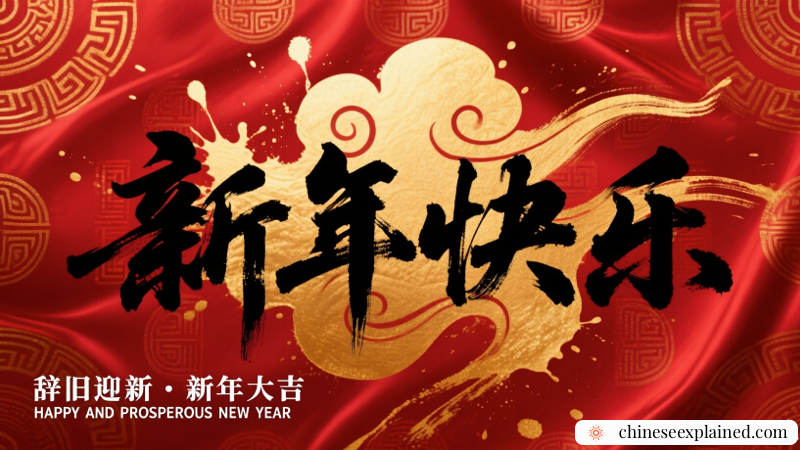
Literally, it means Happy New Year. In real life, it often works as a verbal knock on the door — an opening move before longer wishes follow.
It is what strangers say to each other in lifts. It is what shop owners print on their glass doors.
Simple. Neutral. And impossible to get wrong.
”恭喜发财 (gōng xǐ fā cái)” — wishing fortune, not just luck
Few phrases sound more like Chinese New Year than this one.
“恭喜发财 (gōng xǐ fā cái)” does not mean congratulations in the modern Western sense. It literally means:
May you become wealthy.
It is direct, unapologetic, and deeply practical.
In many families, this line is delivered with a smile and a pause, leaving just enough space for the unspoken reply:
Where is my red envelope?
”身体健康 (shēn tǐ jiàn kāng)” — health before everything else
After a difficult year, this phrase often replaces money wishes.
“身体健康 (shēn tǐ jiàn kāng)” means good health to you. It is most commonly said to parents, grandparents, and older relatives.
The tone is softer. Slower. It reflects a growing awareness in modern China that prosperity is fragile without well-being.
Health, increasingly, comes first.
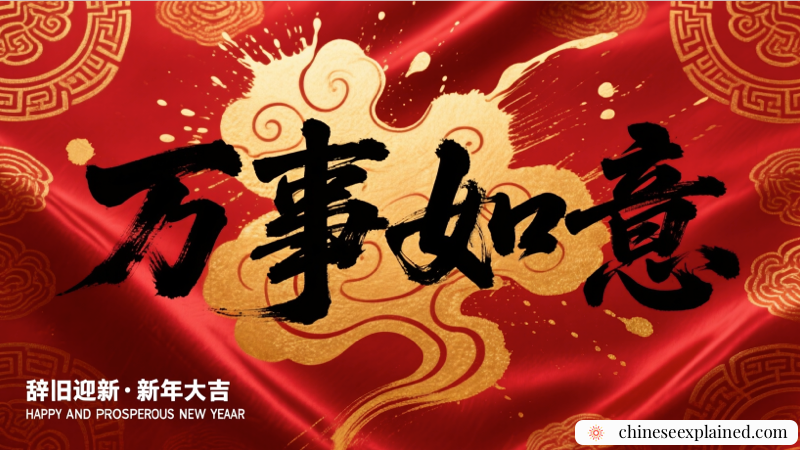
”万事如意 (wàn shì rú yì)” — when you don’t know what to wish
This is the all-purpose blessing.
“万事如意 (wàn shì rú yì)” means may everything go as you wish. It fits almost any situation and any person.
You say it when you do not know someone well enough to tailor a personal message, but you still want to sound sincere.
In that way, it quietly mirrors the social delicacy of Chinese greetings.
”大吉大利 (dà jí dà lì)” — short, rhythmic, and highly shareable
This one feels made for banners and social media.
“大吉大利 (dà jí dà lì)” means great luck and great benefit. It is compact, symmetrical, and easy to chant.
You will see it printed on shop entrances, delivery boxes, and festive posters. It is also popular in online posts, because it looks and sounds good even without context.
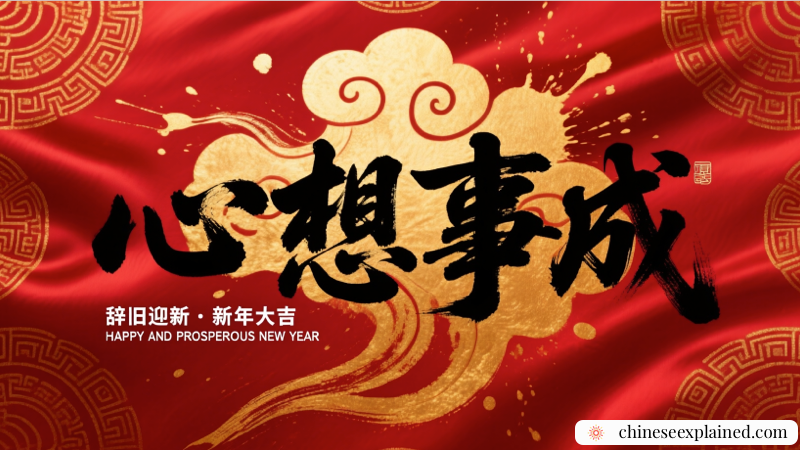
”心想事成 (xīn xiǎng shì chéng)” — wishes that follow the heart
This phrase moves inward.
“心想事成 (xīn xiǎng shì chéng)” means may whatever you wish for come true. It does not specify money, grades, or promotions.
Instead, it quietly acknowledges personal dreams — things that are often left unspoken in everyday life.
It is commonly used among close friends, and increasingly among younger people.
”学业进步 / 工作顺利 (xué yè jìn bù / gōng zuò shùn lì)” — tailored blessings
Here, the greeting becomes customized. • “学业进步 (xué yè jìn bù)” — make progress in your studies • “工作顺利 (gōng zuò shùn lì)” — may your work go smoothly
Children hear the first. Office workers hear the second.
In many households, greetings are adjusted quickly after a glance at who is standing in front of you.
A student, a new graduate, a stressed manager — each receives a different wish.
”阖家幸福 (hé jiā xìng fú)” — the family-first greeting
Chinese New Year is not only about individuals.
“阖家幸福 (hé jiā xìng fú)” means happiness for your whole family.
It reflects one of the most enduring values of Spring Festival: the idea that personal success matters less than collective well-being.
You will hear it especially when visiting neighbours, former teachers, or distant relatives — people who are connected more by family ties than by daily life.
”一路顺风 / 出入平安 (yí lù shùn fēng / chū rù píng ān)” — for those about to travel again
The Spring Festival migration is the largest annual human movement in the world.
So it is no surprise that safety becomes part of the greeting ritual. • “一路顺风 (yí lù shùn fēng)” — have a smooth journey • “出入平安 (chū rù píng ān)” — stay safe wherever you go
They are often spoken at the very end of a visit — right at the door, as shoes are being put on and taxis are being booked.
”红包拿来 (hóng bāo ná lái)” — the playful line every child knows
This is not a formal blessing.
It is a demand.
“红包拿来 (hóng bāo ná lái)” means hand over the red envelope. Children chant it with theatrical confidence. Teenagers say it half-jokingly. Adults pretend to be offended, and then reach for their pockets.
The phrase captures a lighter side of Chinese New Year culture: teasing, bargaining, and ritualised generosity.
⸻
How and when people actually say these phrases during Spring Festival
Most greetings are exchanged during bainian — the New Year visiting ritual known as 拜年 (bài nián).
The pattern is predictable, but never identical.
A short opener. A tailored wish. A laugh. A response that mirrors the original line.
In many families, greetings form a spoken choreography — repeated year after year, yet never entirely mechanical.
From doorsteps to WeChat: how greetings move to screens
Today, a large part of Chinese New Year communication happens on phones.
Group chats light up at midnight with identical lines:
“新年快乐 (xīn nián kuài lè)” “恭喜发财 (gōng xǐ fā cái)” “万事如意 (wàn shì rú yì)”
Digital red envelopes — known as 红包 (hóng bāo) — have turned traditional greetings into clickable rituals.
The words remain old. The speed is entirely modern.
What these ten phrases quietly reveal about Chinese New Year values
Taken together, these greetings sketch a cultural map of priorities.
Money still matters. Health now matters more than ever. Family remains at the centre. Safety, stability, and emotional fulfilment are rising quietly in importance.
For outsiders trying to understand Spring Festival, these phrases are more revealing than any official slogan.
They show what people actually hope for — when the year turns, and the noise begins again.